Free Delivery (by us) for Orders Over $550. Available in VIC metros only.

Tissue paper looks simple, but in business packaging it often does more than add colour. It can make a product feel finished, reduce light surface rubbing, separate items inside a bag or box, and help packing teams work in a more consistent way.
For retailers, ecommerce businesses, gift shops, fulfilment teams and warehouse packers, the practical question is not just whether to use tissue paper. It is which sheet size, colour, thickness and packing method will work reliably across repeat orders. Stanley Packaging supplies tissue paper in a range of business-friendly options, but the right setup still depends on the product, packing workflow and customer presentation goal.
This guide explains how tissue paper is commonly used in product packaging, where it helps, where it has limits, and what businesses should think about before buying it in bulk.
Tissue paper has three jobs in packaging
A useful way to think about tissue paper is to separate its three main roles. The first is presentation: it adds a clean, considered layer between the product and the customer. The second is light surface protection: it can help reduce rubbing between smooth or finished surfaces. The third is packing workflow: it gives packers a repeatable way to wrap, separate or finish orders before they go into a bag, box or carton.
Those roles overlap, but they are not the same. A tissue wrap that looks excellent for a jewellery box may not be the best choice for protecting a ceramic item during freight. A sheet that works well at a retail counter may be too slow or wasteful for a busy fulfilment bench. The better approach is to decide what job the tissue paper needs to do before choosing the colour or quantity.
Common business uses for tissue paper
Tissue paper is widely used across retail and ecommerce because it is flexible, light and quick to apply. It can be folded around a product, used as a lining layer, placed inside a bag, or added between items that may rub during handling.
- Wrapping fashion, accessories, cosmetics, gifts and other customer-facing products before they are placed into paper bags or boxes.
- Separating lightweight items in a multi-product order, especially where presentation matters.
- Adding a clean inner layer for ecommerce parcels, subscription boxes, hamper-style packs and promotional orders.
- Lightly cushioning or filling out a product presentation where heavy protective packaging is not required.
- Creating colour-coded or seasonal packing routines for retail teams and online order fulfilment.
The key is to keep the use realistic. Tissue paper is excellent for presentation and light separation, but it should not be treated as the only protective layer for products that are fragile, heavy, sharp-edged or easily crushed.
Choose colour for both branding and product safety
Colour is one of the main reasons businesses choose tissue paper. White, kraft and neutral shades create a clean, simple look. Pastel shades can suit lighter retail packaging. Strong colours such as black, red, navy or metallic tones can create a more premium or seasonal effect.
However, colour choice should not only be about brand fit. If the tissue paper will touch the product directly, think about the product surface, the expected handling conditions and whether there is any moisture or friction risk. Dark or highly coloured tissue may be better used as an outer presentation layer rather than the first layer against pale fabrics, matte finishes, unsealed surfaces or moisture-sensitive products.
A practical approach is to use white, kraft or a lighter neutral tissue as the contact layer when product marking is a concern, then add coloured tissue as the visible outer layer if presentation is important. This keeps the look intentional without making colour do a job it may not be suited for.
Sheet size can affect speed, waste and presentation
Many businesses focus on colour first and sheet size second. In day-to-day packing, sheet size often has a bigger impact than expected. If the sheet is too small, packers may need to use two sheets or fold awkwardly around the product. If it is too large, the finished parcel may look bulky and the business may use more material than needed.
Tissue paper also has to wrap a three-dimensional product, not just cover a flat measurement. A product that looks small on a shelf may still need extra length to wrap over corners, around height, or under a folded edge. For ecommerce teams, the best sheet size is usually the one that creates a neat result with the fewest extra folds and the least variation between packers.
When testing a tissue paper size, pack several real orders rather than measuring one product on a desk. Check whether the wrap sits neatly, whether packers can repeat it quickly, and whether the finished product still fits comfortably into the selected box, satchel or bag.
GSM and thickness should match the packing job
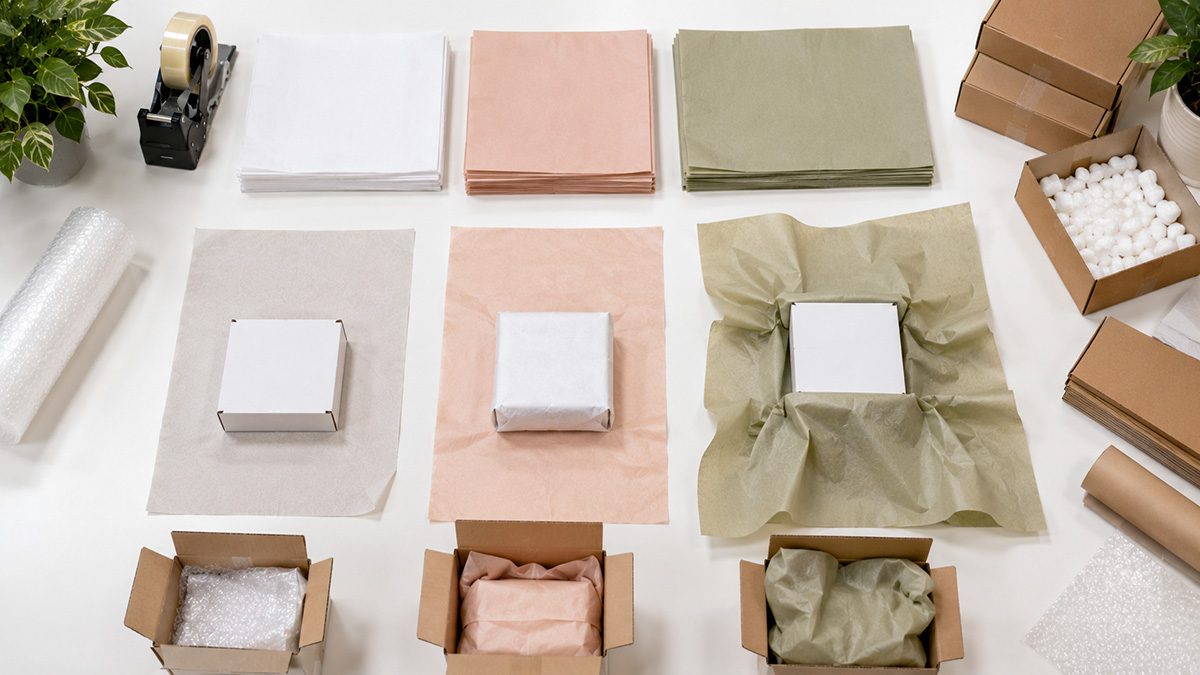
Tissue paper thickness affects how it handles. Lighter tissue can be easier to fold, gather and shape around products. Slightly heavier tissue can feel more substantial and may be less prone to tearing during normal wrapping. Neither is automatically better; it depends on the packing job.
For delicate retail presentation, a lighter sheet may create a softer wrap and cleaner folds. For larger products or more frequent handling, a slightly more substantial sheet may be easier for packers to manage. If the product has corners, edges or a rough surface, thickness alone is not enough. The packing method and outer packaging still matter.
The safest way to choose is to test the paper with the actual product, the actual packing method and the actual outer packaging. A tissue paper that looks good flat may behave differently once it is folded, tucked, sealed, stacked or placed into a parcel.
Bulk buying should be judged by cost per packed order
Buying tissue paper in bulk can make sense for businesses that pack repeat orders, but the useful number is not only cost per sheet. A more practical measure is cost per packed order. That includes how many sheets are normally used, how often the colour changes, how quickly staff can pack, how much storage space the stock needs, and whether running out of a colour disrupts the packing process.
For example, a tissue paper that is slightly cheaper per sheet may not save much if packers need to use two sheets for common products. A colour range that looks good online may create unnecessary stock complexity if only two colours are used regularly. On the other hand, keeping one reliable base colour plus one or two seasonal or brand colours can make bulk buying easier to manage.
For small and large ecommerce operations alike, repeatability matters. If the same product is packed the same way each time, it is easier to train staff, forecast stock use and keep the customer experience consistent.
How to build a practical tissue paper setup
A simple tissue paper setup usually works better than a complicated one. Start with the products that are packed most often, then choose the sheet size and colour range around those products rather than around every possible product variation.
- Choose one reliable base colour, such as white, kraft or a soft neutral, for regular packing.
- Add one or two brand or seasonal colours only if they are used often enough to justify stock space.
- Test sheet size against real products and finished parcels, not just product dimensions.
- Decide whether tissue paper is being used for presentation, surface separation, light fill, or all three.
- Set a simple packing method so the finished order looks consistent across different staff members.
This type of system is useful for fashion, gifts, homewares, cosmetics, retail counters and general ecommerce packing. It also helps larger fulfilment teams avoid overcomplicating the packing bench with too many colours or sizes that only suit occasional orders.
Tissue paper should not replace protective packaging
Tissue paper can help with surface contact, light separation and presentation. It is not designed to do the same job as cushioning, void fill or a strong outer carton. If a product is fragile, heavy, pressure-sensitive or likely to move during transport, it should be packed with the right protective materials as well.
For fragile items, tissue paper may be useful as a first presentation layer, but the protective work may need to come from bubble wrap, void fill and a correctly sized mailing box. For heavier goods or larger shipments, tissue paper can still improve presentation inside the parcel, but the outer packaging should be chosen for transport strength.
This distinction is important because customers notice both outcomes: how the product looks when opened, and whether it arrives in good condition. Tissue paper supports the first outcome and can contribute to the second, but it should not be expected to solve every transport risk on its own.
When kraft paper or wrapping paper may be a better fit
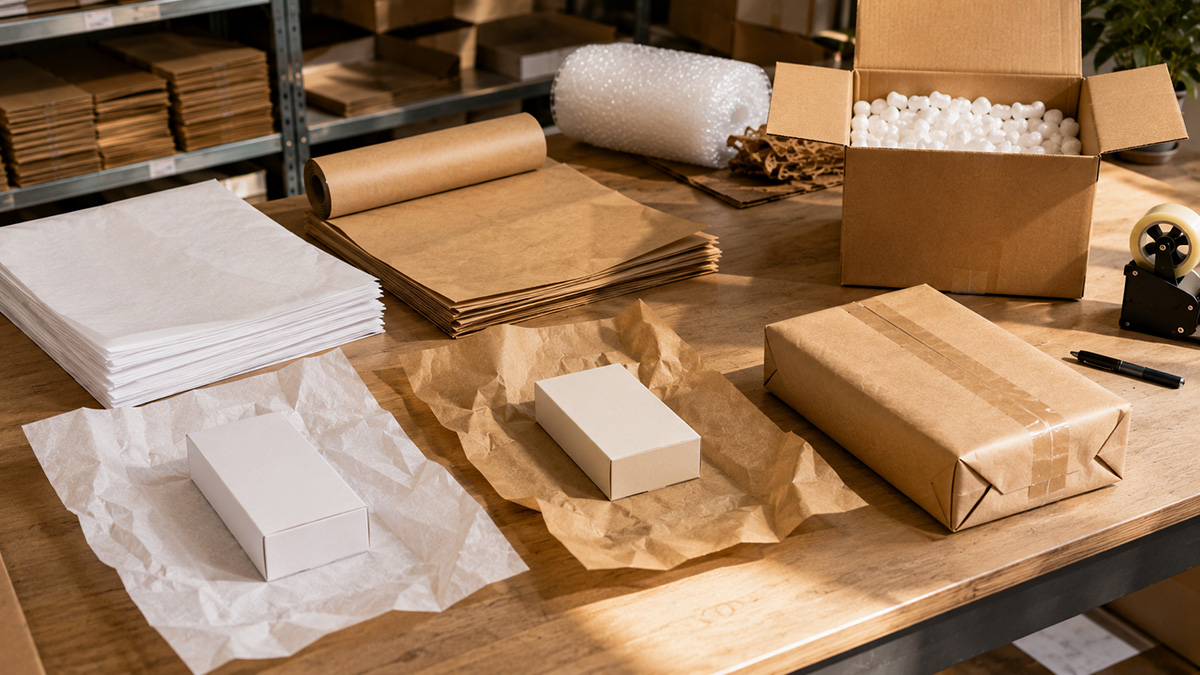
There are situations where tissue paper is not the most practical wrapping material. If the product needs a stronger wrap, more resistance to tearing, or a plainer utility finish, kraft paper or other wrapping paper options may be more suitable.
A useful way to choose is to ask whether the wrapping layer is meant to look soft and decorative, or whether it needs to behave more like a practical protective wrap. Tissue paper is usually better for light presentation and surface separation. Kraft or heavier wrapping paper may be better when durability and coverage matter more than softness.
Quick selection guide
| Packaging need | Tissue paper role | Practical note |
| Retail presentation | Creates a finished inner wrap or bag liner. | Choose colour and sheet size for consistency across staff. |
| Light surface separation | Helps reduce rubbing between smooth or finished products. | Use caution with dark colours against pale or moisture-sensitive items. |
| Ecommerce packing | Adds an organised layer before the product goes into a box or satchel. | Do not rely on it as the only protective layer for fragile goods. |
| Bulk fulfilment | Supports repeatable packing routines. | Judge value by cost per packed order, not just cost per sheet. |
| Heavier or fragile goods | May be used as a presentation layer only. | Pair with suitable cushioning, void fill and outer packaging. |
FAQ
What is tissue paper used for in packaging?
Tissue paper is commonly used for retail presentation, light surface protection, product separation, bag lining and ecommerce order wrapping. It is best used as a finishing and separation layer rather than the only protective material for fragile products.
Is tissue paper protective enough for shipping?
Tissue paper can help reduce light rubbing and improve presentation, but it is not a replacement for bubble wrap, void fill or a suitable outer box when the product is fragile, heavy or likely to move in transit.
What colour tissue paper should a business choose?
Many businesses use white, kraft or neutral tissue as a reliable base colour, then add brand or seasonal colours where presentation matters. Dark or strongly coloured tissue should be used carefully when it may touch pale, unsealed or moisture-sensitive products.
Is thicker tissue paper always better?
Not always. Thicker tissue can feel more substantial, but lighter tissue may fold and shape more easily. The right choice depends on the product, wrapping method, presentation goal and packing speed.
Is it better to buy tissue paper in bulk?
Bulk buying can work well for businesses with repeat packing needs, but it should be judged by cost per packed order, storage space, colour usage and packing consistency rather than sheet price alone.
Can tissue paper be used with mailing boxes or paper bags?
Yes. Tissue paper is often used as an inner wrap before products are placed into mailing boxes or paper bags. It can improve presentation and help separate products, while the outer packaging handles the main transport or carrying function.